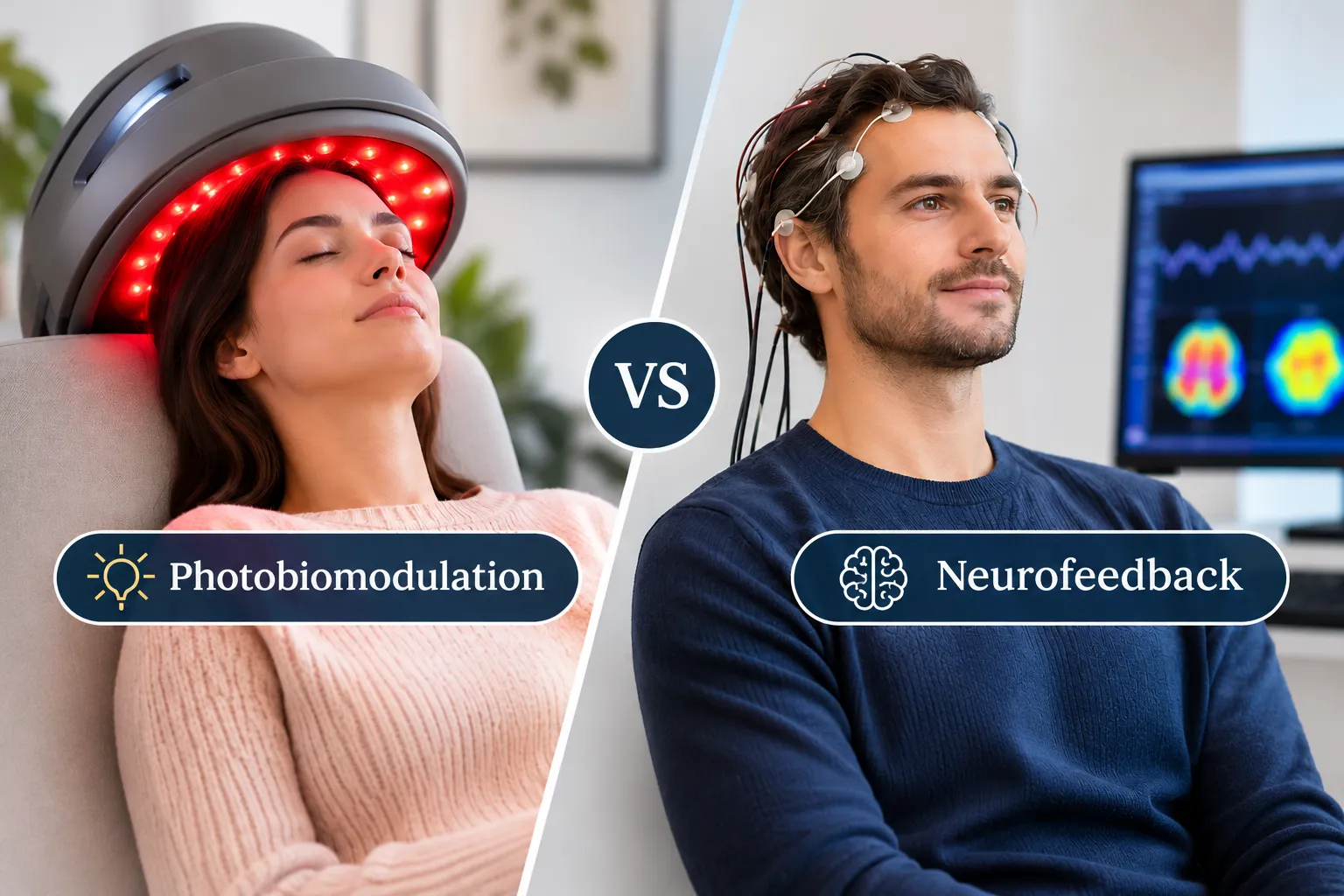
As researchers study different possibilities in brain health, they are exploring several approaches to brain function. Two approaches that have become popular are photobiomodulation and neurofeedback. Although both are used in the brain health field, they are very different from each other.
This overview may be useful for people learning about personalized brain health services in NYC and Long Island. At NY Neurofeedback, Dr. Merlyn Hurd and the team offer personalized brain health services, including photobiomodulation, QEEG brain mapping, and neurofeedback.
What Is Photobiomodulation?
Photobiomodulation is a technique that uses specific red or near-infrared wavelengths of light to stimulate certain biological processes in the body’s tissue. Researchers are currently studying how this light may influence certain cellular processes.
In brain health, researchers are studying the connection between photobiomodulation, blood flow in the brain, and cellular activity. Study results so far are mixed, so its clinical applications are still being worked out. For a deeper look at the research, read Photobiomodulation and Brain Health.
What Is Neurofeedback?
Neurofeedback is brain training based on real-time feedback about the brain’s electrical activity.
During a session, sensors record brain activity while a computer program gives visual or audio feedback. For example, a person may watch a movie or listen to music during training.
Research on neurofeedback for attention, self-regulation, and other concerns is ongoing. It may help in some cases, but not in all of them, and there is no guarantee that it will work.
Photobiomodulation vs. Neurofeedback: What Is the Difference?
The key difference is how each one works. Photobiomodulation uses specific wavelengths of light to affect biological tissue and its cellular processes. Neurofeedback uses real-time information about the brain’s electrical activity during training.
| Feature | Photobiomodulation | Neurofeedback |
|---|---|---|
| What it uses | Specific red or near-infrared light wavelengths | Real-time readings of the brain’s electrical activity |
| How it works | Light interacts with biological tissue and cellular processes | Visual or audio feedback is given during training |
| Research status | Emerging; clinical applications still being studied | Studied for attention and self-regulation; results vary |
Personalized Brain Health Care in NYC
At NY Neurofeedback, personalized care starts with understanding each patient’s needs and goals. Depending on those needs, QEEG brain mapping may be used as part of an individualized evaluation.
Led by Dr. Merlyn Hurd, PhD, QEEG-DL, NY Neurofeedback provides brain health services to children, teens, and adults in NYC and Long Island.
If you are interested in learning more about photobiomodulation or neurofeedback in NYC, reach out to NY Neurofeedback to learn about its services and whether an initial consultation might be right for you. You can book a consultation or contact the team directly.
Contact NY Neurofeedback
Website: www.nyneurofeedback.com
Phone: +1 (917) 405-8168
Email: merlynh@nyneurofeedback.com
This article is for educational purposes only and should not replace professional medical advice, diagnosis, or treatment.
Read our next blog — Photobiomodulation and Brain Health: How Near-Infrared Light Is Being Studied for Cognitive Function