

How Can I Tell If Neurofeedback Is Right for Me?
Who can benefit from neurofeedback? What does QEEG have to do with it? What should I take into account before starting in NYC?

It may be that you've learned of neurofeedback from a friend, found an article on it online, or perhaps even discovered it while seeking alternatives for improving focus, sleeping well, anxiety, or brain wellness.
And now you're probably asking yourself:
"Will neurofeedback work for me?"
It's a valid question.
The answer isn't quite a simple yes or no. Not everyone needs neurofeedback, it isn't a catch-all remedy, and it certainly doesn't aim to supplant all other methods of treatment. It is, or it isn't, suited for you based on a number of personal factors.
In some cases, the best course may involve consulting a doctor or a mental health professional. In others, a brain-based assessment and neurofeedback could be a worthwhile venture.
The key is in knowing the possibilities you have available to you.
What Is Neurofeedback?
Neurofeedback is an entirely non-invasive training method that utilizes information about the functioning of the brain to give feedback.
EEG sensors pick up electrical brain activity and use the acquired information to give feedback during a specially designed activity.
In essence, the approach is straightforward:
Measuring → Getting feedback → Practicing → Learning
Instead of giving commands to your brain, neurofeedback gives information that your brain can learn to utilize.
Here at NY Neurofeedback, neurofeedback is a component of a more comprehensive individualized plan that starts with assessment and treatment plan development.
However, before considering neurofeedback as the solution to your problems, it might be useful to consider what kind of problems you need help with.
Begin With the Problem, Not the Solution
For example, when a person states:
“I am unable to concentrate.”
There are many reasons that may be behind that statement.
They could not be getting sufficient sleep.
They could be experiencing stress.
They could have anxiety.
They could have difficulty concentrating from a very young age.
Or perhaps their lives have become particularly tough for some time.
It works the same way with sleep, mood, and stress.
Different people can suffer from the same symptoms because of entirely different situations.
This is why the right beginning is not:
“Should I use neurofeedback?”
But rather,
“What am I suffering from and what would I like to change?”
Whom Might Explore Neurofeedback?
Research into the effectiveness of neurofeedback has been conducted in a number of domains such as attention, anxiety, sleep, and other features of mental and cognitive processes. Nevertheless, the quality of research varies significantly from case to case.
A person may want to explore the possibility of using neurofeedback if they experience problems such as:
Attention and concentration issues
Sleep issues
Stress and relaxation issues
Anxiety issues
Emotional regulation issues
Mental tiredness
Other cognitive and behavioral issues
The occurrence of any of these problems does not necessarily mean that neurofeedback should be used.
Need a Personalized Solution?
This could be the main reason behind why anyone gets attracted to neurofeedback.
There are never any two brains that are exactly alike.
Even if two individuals exhibit the same symptoms, their circumstances can be vastly different.
Let's look at two individuals who both claim:
"I am unable to sleep."
One individual could be working on an irregular schedule.
The other could be suffering from constant anxiety.
Yet another could have a completely different issue altogether.
Applying the exact treatment to all three individuals might not make much sense.
The idea behind a personalized solution involves posing certain questions about the individual first.
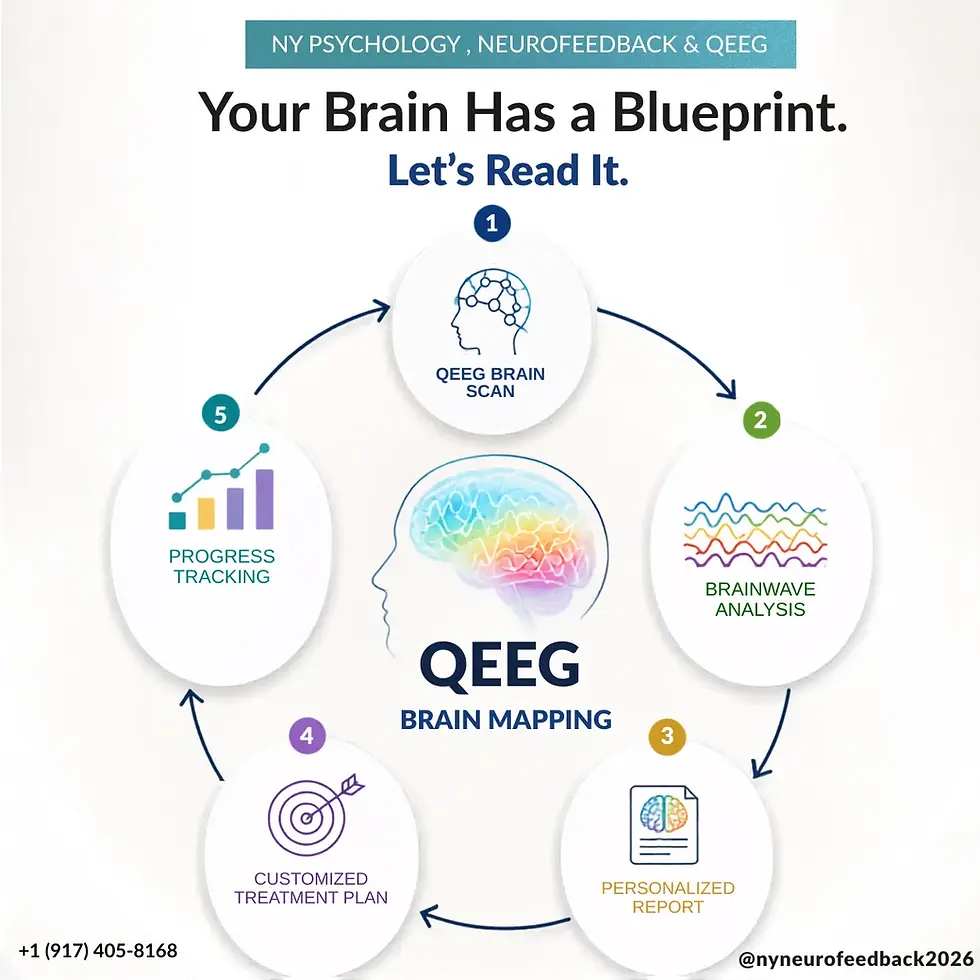
What does QEEG have to do with neurofeedback?
If you have been looking into neurofeedback, then you must have heard about something called QEEG.
QEEG stands for quantitative electroencephalography.
Simply put, it is about recording and analyzing your brainwaves using EEG technology.
Consider it a piece of additional information.
Your mind may express itself as follows:
"My mind feels constantly busy."
QEEG could give you information on the activity patterns in your brain that could be taken into account along with your background, symptoms, and clinical examination.
At NY Neurofeedback, QEEG brain mapping is used as part of the examination process in order to aid the creation of an individualized treatment plan.
Still, it is crucial not to overestimate what QEEG is good for.
A QEEG is not a crystal ball and it cannot be used for diagnosis of all mental disorders.
It is a piece of information that could help professionals understand the bigger picture.
You can find out more on the subject through the NY Neurofeedback's QEEG brain mapping guide.
Is There Scientific Evidence Supporting Neurofeedback?
It is a significant question – and the answer can only be that the scientific evidence base is still growing.
Neurofeedback has been researched for various disorders, but not all research gives the same outcomes.
For instance, a 2025 systematic review and meta-analysis that was published in JAMA Psychiatry reviewed randomized controlled trials on the efficacy of neurofeedback therapy for attention deficit hyperactivity disorder (ADHD). The authors noted there was no statistically significant effect on probably blinded ADHD symptom ratings, although there were some positive results in some analyses. They also mentioned the necessity for future studies.
Studies of anxiety have provided some optimistic outcomes, but some systematic reviews highlighted the drawbacks in study quality and protocol diversity.
Thus, it would be better to refrain from phrases like:
“Neurofeedback helps everybody.”
What one can say instead is:
Neurofeedback may be an effective treatment tool for some people.
And this is a much more meaningful discussion for a person who is considering undergoing the procedure.
What If You’ve Already Tried Something Else?
Maybe you’re thinking about neurofeedback because you’ve already tried something else.
You may have had therapy.
You might have had a discussion about medications with your healthcare provider.
You may have made changes to your sleep, workout, and other routines.
Maybe something helped, but it didn’t help enough.
That’s good information to bring into your decision-making process.
As you consider neurofeedback, you shouldn’t exclude the information about your past experiences.
Instead, ask yourself:
What helped me?
What didn’t?
What am I still having trouble with?
What would I like to see different?
Do you Expect a Quick Solution?
This is yet another important aspect to consider.
Most neurofeedback practices involve a process of training, rather than quick solutions.
Therefore, an individual who is thinking about neurofeedback should be ready to undergo many sessions and to assess one’s progress throughout the entire period.
The required number of sessions is different for each individual.
It is reasonable for a responsible professional to discuss the following issues with the patient:
• The assessment process;
• The training process;
• The frequency of sessions;
• How the progress is going to be assessed; and
• What happens in case of no progress.
Is Neurofeedback Able to Complement Other Treatment Methods?
Possibly, yes.
Opting for neurofeedback is not automatically synonymous with not considering any other type of treatment method.
An individual might engage in therapy at the same time as they try neurofeedback.
Some individual may be continuing on their prescribed medicine even as they undergo neurofeedback training.
It all depends on what suits one the most, as treatment does not have to be either/or.
If an individual is on prescribed medication, do not abruptly discontinue its use in favor of neurofeedback.
What Questions Should I Ask Before Getting Neurofeedback?
If you are thinking about starting neurofeedback in NYC, do not hesitate to ask some questions.
Here are a few of them:
1. What can I expect during the initial assessment?
Make sure you are aware of what kind of data will be collected from you before the process starts.
2. Will there be a QEEG included in the initial assessment?
If yes, then find out what it is going to measure and how it will affect your neurofeedback plan.
3. How will my neurofeedback plan be personalized?
Find out what makes this neurofeedback plan individual for you.
4. How will we determine that the neurofeedback is working?
You need to have an idea about whether it works or not; otherwise, you cannot continue forever.
5. What are my other options?
Need Neurofeedback in NYC?
When looking for "neurofeedback near me," "neurofeedback NYC," or "QEEG brain mapping NYC," you might be tempted to go with the first clinic you see.
Before doing so, however, take some time to learn more about the therapy.
Consider the following:
The background of the therapist
The assessment method used
The services provided
How customized the treatment is
How progress is tracked
If there's encouragement to ask questions
At NY Neurofeedback in NYC, the therapy applies an Assess, Plan, and Treat process that includes QEEG and neurofeedback within a customized treatment model.
Should you be wondering if this form of treatment would be beneficial to you, then a consultation could be the right step to take.
Is Neurofeedback Suitable for Me?
If the following applies to you, neurofeedback might be worth considering:
If you have issues that you wish to resolve.
If you are interested in a non-invasive method of brain training.
If you are comfortable with the assessment prior to starting training.
If you want a customized treatment program.
If you are willing to go through a process and not expect immediate results.
If you would like to know more before making up your mind.
However, there is another equally important aspect:
You do not need to make up your mind beforehand.
This is what the consultation is all about.
You can ask questions, share your experience and see if it fits you to proceed with the assessment.
Frequently Asked Questions
Is neurofeedback for everyone?
No. Not everyone can benefit from neurofeedback, nor does everyone need to use it. Its relevance depends on the needs of each particular case.
Can neurofeedback treat anxiety?
Some studies have been carried out regarding the role of neurofeedback in dealing with anxiety, but there is not enough evidence to state it can definitely treat it.
Can neurofeedback treat ADHD?
Many studies of neurofeedback in ADHD were performed, but their outcomes are rather diverse. A recently performed meta-analysis showed different results according to the goal and neurofeedback protocol used.
Do I need QEEG before neurofeedback?
It depends on the clinic where you will seek neurofeedback therapy. NY Neurofeedback performs QEEG brain mapping as a part of personalized plan formation.
Does QEEG diagnose mental health disorders?
No. QEEG gives you the idea of brainwaves activity, but it cannot be considered a separate tool of diagnosing disorders like anxiety or depression.
Is neurofeedback the same as medication?
No. While medications use pharmaceutical agents to affect your organism, neurofeedback uses EEG feedback during the process of training.
Can I have neurofeedback if I’m on medication?
This is something you should speak with your healthcare professionals about. Don’t take any action regarding your medication without consulting the prescriber of that medication.
How many neurofeedback sessions will I require?
There is no single answer to this question. It all depends on the person, their goals, evaluation, and response to neurofeedback.
Where can I get neurofeedback in NYC?
NY Neurofeedback offers neurofeedback and QEEG testing in New York. You can find out more information about NY Neurofeedback practice at nyneurofeedback.com.
The First Step Is Not Choosing a Treatment Option
When facing problems like lack of concentration, insomnia, stress, anxiety, or any other issue, it is natural to hope for a quick solution.
However, sometimes the best starting point is not:
“What treatment option should I pursue?”
Rather, it is:
“What do I need to know first?”
Your symptoms matter.
Your past matters.
Your goals matter.
And the best way forward can vary depending on your case.
For one patient, neurofeedback might be just what the doctor ordered, whereas another will find something else more suitable.
You don't have to find out on your own.
A proper consultation will allow you to learn what your options are and choose the next best step for you.
Looking to consider neurofeedback in New York?
Get acquainted with NY Neurofeedback and learn about the process Getting Started at the practice.
Begin with a question. Begin with knowledge.
Book your Consultation now - Dr. Merlyn Hurd


Comments