

Neurofeedback vs. Medication for Anxiety: Easy to Understand
If your anxiety is now interfering with your sleep, focus, relationships, work, or daily functioning, you might be considering your possible courses of treatment.

One common question to be asked in this context is:
Is neurofeedback better than medications for anxiety?
It is not an easy answer.
While medication is a biological treatment, neurofeedback is based on feedback of brain activity during the training sessions.
In some cases, medication can be a part of treatment. With others, therapy, neurofeedback, changing lifestyles, or other approaches might be taken into account.
The decision about which treatment is more suitable will depend on such factors as the person, his or her symptoms, medical history, and goals of the treatment. According to the National Institute of Mental Health, anxiety disorders can be treated by therapy, medications, or both.
NY Neurofeedback in NYC starts with a proper understanding of the individual instead of treating everyone suffering from anxiety in the same manner.
What Is Medication for Anxiety?
Medication helps decrease symptoms of anxiety by affecting the chemicals in your brain.
Based on your specific anxiety, healthcare professionals may prescribe:
SSRIs
SNRIs
Buspirone
Anti-anxiety medication
Other medications based on your individual circumstances
For instance, SSRIs and SNRIs are the most popular for anxiety disorders and they usually take several weeks to show their maximum results. Certain medications have possible side effects, which is why a medical professional should decide on medications for you.
Medication can be useful for many patients; however, it may not be the only method.
Anxiety affects thinking, emotions, sleep, attention, behaviors, and physiological activation. That is why some individuals try to find another way to approach their problem, from a different perspective.
What Is Neurofeedback?
Neurofeedback is a type of brain-based training using EEG data for real-time feedback.
Simply put:
Your brain creates electrical activity.
This activity is recorded by the EEG apparatus.
Then, a computer gives you feedback based on your brain activity.
With repeated training sessions, one gets feedback helping to facilitate learning and regulate certain brain activity.
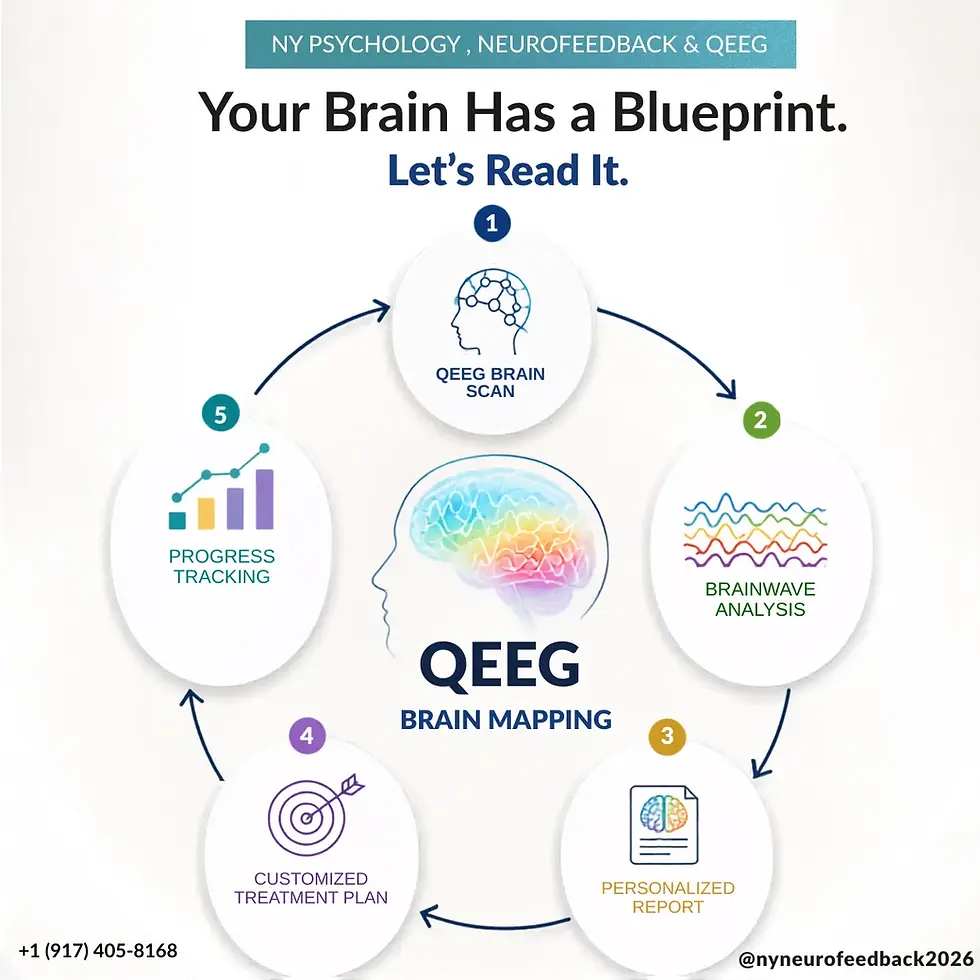
At NY Neurofeedback, the procedure starts with assessment and QEEG brain mapping. The clinic defines its procedure as:
Assess → Plan → Treat.
The QEEG procedure is utilized in order to get information about brain activity in order to develop an individualized neurofeedback protocol.
More information on the topic can be found here in QEEG Brain Mapping: How Does It Work?
Neurofeedback vs. Medication: The Basic Difference
The simplest way to think about the difference is:
Medication | Neurofeedback |
Uses medication to influence biological processes | Uses real-time EEG feedback as part of brain training |
Prescribed and monitored by a medical professional | Conducted through structured neurofeedback sessions |
May help reduce anxiety symptoms | Aims to train regulation of brain activity |
Effects can vary between medications and individuals | Protocols can be individualized based on assessment |
May involve side effects | Non-invasive and does not involve taking medication |
This doesn't mean one approach is automatically better.
That does not mean that one of the methods is always better.
These are simply two different methods.
And sometimes, both are used.
According to the American Psychological Association, psychotherapy and medications are both effective treatments for anxiety disorders, which depend on individual cases.
Where Does QEEG Come Into Play?
And this is when things get personal.
QEEG, which stands for quantitative electroencephalogram, measures and analyzes brainwave activity based on some sort of reference data.
The question will not be:
“What are your symptoms?”
but also:
“What is your brain activity like?”
According to NY Neurofeedback, the QEEG procedure entails examining brain activity in both active and passive modes in order to use this information for tailoring a treatment program.
It is essential to remember that QEEG must not be used as a stand-alone diagnostic tool for an anxiety disorder. Clinical history and assessment are still vital.
What it can offer is additional information that may be helpful in developing a personalized treatment strategy.
Neurofeedback for Anxiety: What Has Research Found?
Research in neurofeedback treatment for anxiety is promising and still emerging.
The systematic review of studies on biofeedback and neurofeedback suggested that biofeedback techniques can be beneficial for anxiety, but pointed to the drawbacks and gaps in the literature, as well as the necessity to conduct more controlled research.
Another line of research investigating EEG neurofeedback also produced quite positive results. In particular, one review stated that neurofeedback based on EEG was a promising non-drug technique to use for anxiety and PTSD, although the methodological restrictions prevented determining the exact mechanism behind the results.
There are also smaller research studies concerning QEEG-based neurofeedback for generalized anxiety disorder. Thus, one randomized study that included 29 students showed improvement in the participants after undergoing the QEEG-based neurofeedback protocol, yet the small sample does not allow making too strong conclusions.
And here is the appropriate conclusion from all the above:
Neurofeedback can be a helpful treatment choice for anxiety, but it should not be considered a guaranteed solution or a substitute for existing techniques.
Can Both Neurofeedback and Medication Work Together?
Yes, but potentially.
Not all treatments need to be either-or choices.
One can work with one's health practitioner on medications while simultaneously receiving psychotherapy and neurofeedback therapy.
Coordination is key.
Under no circumstances should anyone stop, lower, or alter anxiety medications without talking with one's prescribing health practitioner.
According to the NIMH, treatment should consider each patient's specific medical conditions.
At NY Neurofeedback, both psychological treatment and neurofeedback therapy are a part of the overall personalized approach of the clinic.
How Do You Choose the Correct Approach?
Instead of asking:
"Which therapy is better?"
It could be more helpful to ask yourself the following question:
"What is the approach that will be appropriate for me?"
Think about such questions as follows:
Which symptoms interfere with my everyday life?
How long have I had these problems?
Are there any sleep and concentration issues as well?
Do I take some medicine now?
Is there a therapist/physician who helps me?
What are my treatment objectives?
Could I benefit from a neurological assessment?
How do we measure progress?
For those who would like to try neurofeedback in NYC, a consultation can be the right starting point for such a discussion.
NY Neurofeedback’s Getting Started guide will help you find out more about it.
Common Questions
Which is more effective for anxiety—neurofeedback or medication?
There is no definite answer to this question, as each treatment approach works differently, and there is no universal treatment that works equally well for everybody. Medication is a proven treatment for anxiety disorders, whereas neurofeedback is still in the process of development.
Can neurofeedback serve as a substitute for anxiety medication?
Not necessarily. If you are currently using any prescribed drugs, you need to discuss this issue with your health care provider.
Is neurofeedback associated with medication?
No, it is not. Neurofeedback entails recording brain activity with the use of sensors and giving you some feedback in the course of the process. NY Neurofeedback explains their neurofeedback sessions as being EEG-based and non-invasive.
What is QEEG?
Quantitative electroencephalography (QEEG).
Does QEEG diagnose anxiety?
The QEEG should never be thought of as an independent diagnostic tool for anxiety disorders. This tool provides information about the activity in the brain that might help to consider alongside other factors such as clinical history and evaluation.
Where to find neurofeedback in NYC?
Yes, there are neurofeedback specialists. NY Neurofeedback gives individualized neurofeedback sessions using QEEG in New York City.
How to start neurofeedback for anxiety?
It will be good to start by discussing your symptoms, aims, and treatment history with a professional. NY Neurofeedback starts with a consultation/clarity call.
Conclusion: Consider the Person As a Whole, Not Only the Symptom
Every person experiences anxiety differently.
For example, one feels constantly worried, another suffers from panic attacks, bad sleep, body tension, lack of concentration, or even a combination.
This is why the discussion of neurofeedback vs. medication for anxiety cannot be just a choice of one option.
Medications may be a useful tool in this endeavor. Psychotherapy may assist individuals to understand and alter patterns of thoughts and behavior. Neurofeedback presents yet another alternative using real-time EEG feedback and, with the right assessment ahead of time, is a modality that can be included in brain training programs.
For those in NYC seeking a more personalized approach, learning about your symptoms is part of the equation. Learning more about your brain might give you even more information.
Should you wonder whether QEEG and neurofeedback might be a good fit for your goals, you can learn more about the method on the NY Neurofeedback website or on the Getting Started page of the practice.
It is not about treating the label. It is about treating the individual behind it.


Comments