

Ways to Improve Mental Well-Being: Small Measures That Can Make a Difference

Content:
What mental health and well-being actually mean
Everyday ways to support mental health
Why sleep, movement, connection and routine matter
When everyday changes may not be enough
When it may be useful to talk to a professional
Why personalized mental-health care matters
Where neurofeedback and QEEG may fit
How NY Neurofeedback approaches assessment
When someone in NYC might consider professional support
Simple questions to ask before choosing a provider
What Is Mental Well-Being? How to Approach Everyday Well-Being and Consider Personalized Treatment Options
Mental well-being isn't an issue that comes up only when there is something serious going on.
It is also one of the ways in which you manage stress, sleep, relationships, work, studying, changes in life, and other challenges.
There will be days when you will be completely in control and energetic. There will also be days when getting through your daily routine will be a real challenge.
And that doesn't mean that there is something wrong with you.
It just means that sometimes there is something that requires your attention.
And the good news is that sometimes improving your mental well-being doesn't require taking drastic measures.
The Complexities of Mental Health and Wellbeing
Mental health is not simply the absence of anxiety or depression.
It also covers your thinking, feeling, functioning, interactions with others, and coping mechanisms.
Wellbeing may involve:
Feeling connected with other people
Adequate rest
Stress management ability
Meaningful activities
Feeling competent to cope with challenges
Recognizing when to seek assistance
Mental well-being varies during one’s lifetime. Stressful events, lack of sleep, life changes, problems with relationships, or constant pressure may impact feelings and functioning of a person.
This explains why it may be necessary to take care of mental health on an ongoing basis rather than dealing with issues only at the crisis point.
Easy Ways to Help With Your Mental Well-Being
One routine will not apply perfectly to all people.
However, there are some things that we can do every day to maintain our mental health.
Obtain Regular Sleep
Sleep and mental well-being are interconnected.
While the importance of getting a lot of sleep is stressed, it is important to think about your sleep pattern instead.
Having regular sleep times and relaxing before bedtime can help you obtain regular sleep and have better mental well-being.
However, if obtaining sleep becomes a challenge for you every night, it might be necessary to talk to a healthcare provider.
Exercise
Working out hard every day is not needed.
A simple walk, dance, stretching, or other exercises are enough to help you exercise every day.
It is not important to achieve perfection but to be consistent in doing something.
Stay Connected
In moments when you're feeling emotionally distressed, being alone can add more weight to the issue at hand.
Discussing things with your friend, family member, coworker, instructor, or anyone else you trust will foster a feeling of connection.
You may not necessarily need someone to find the solution for you.
It is often enough to feel that you've been heard.
Give Your Brain a Break
Your brain does not need to constantly function.
A moment of taking a short break from whatever task you have to complete, notifications, social networks, and constant activity can help you gain some relaxation time.
Go outdoors.
Put your phone down.
Listen to some music.
Take a walk.
Spend some time in silence.
When Your Normal Methods Just Don’t Cut It
Even if you’ve done everything you could to get better sleep, physical activity, socialization, and develop a good routine, something just might not feel right.
If:
You are experiencing anxiety often.
You have been sad for several weeks.
You struggle to focus like before.
You are always feeling tired.
Your sleep is still disturbed.
It’s hard for you to enjoy things you used to enjoy.
Stress starts affecting your work, school, relationships, or daily life.
Then it might be time to consider professional help.
According to the American Psychological Association, one should consider therapy if there are issues that affect life like persistent sadness, worry, concentration difficulties, or problems with completing normal activities.
And it does not mean that you failed on your own.
It means that you take it seriously.
What if the Same Symptom Looks Different for Different Individuals?
Consider two individuals making this statement:
“I can’t focus.”
One individual may not be getting enough sleep.
One may be feeling anxious.
One may have attention problems for a long time.
One may just feel overwhelmed by what’s going on in his or her life.
The sentence is the same.
The individual is not.
This is one example why personalized mental health care may be useful.
Instead of thinking everyone needs the same treatment, the professional can consider the individual’s issues and circumstances.
Where Does Neurofeedback Play a Role in Mental Health Services?
And here comes NY Neurofeedback which goes about it in a different way.
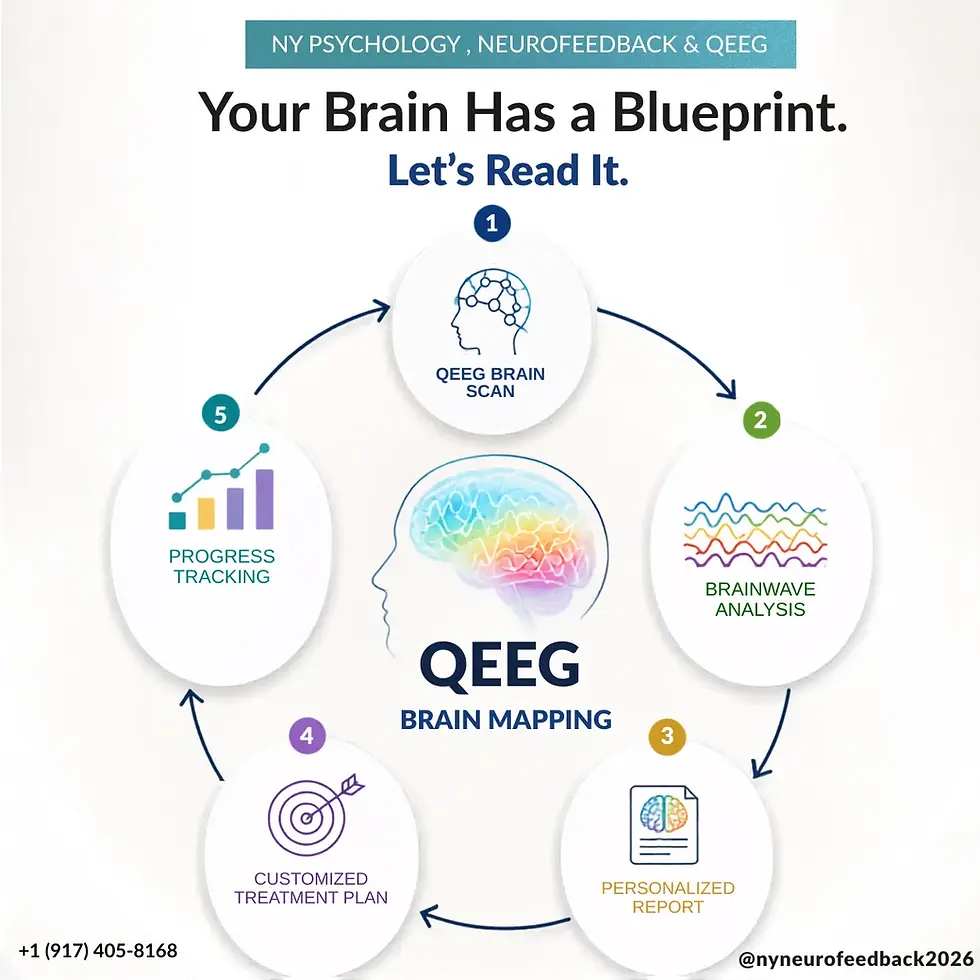
NY Neurofeedback follows a three-stage procedure:
Assessment → Planning → Treatment
The first stage is the QEEG brain mapping.
Based on NY Neurofeedback, brain mapping evaluates the brain's behavior both in the active and passive modes and gives information that is used to create a unique psychological and neurological treatment plan for an individual patient.
Then comes analysis of this information along with problems and concerns of the individual.
A neurofeedback protocol and psychological treatment plan are created by the NY Neurofeedback using individual brain information and treatment goals.
In neurofeedback sessions, EEG feedback is provided to the patient while performing activities like watching favorite movies or listening to music.
That being said, neurofeedback therapy does not suit all patients automatically.
One must begin with the assessment and conversation stage.
The Importance of Personalized Care
Imagine you are shopping for a new pair of shoes.
Of course, you would not assume that one size fits all.
Though mental health treatment is more complex than shoes, this illustration is still important.
Different patients need different things.
Your issues, background, lifestyle, personal goals, and reactions to prior treatments might be relevant.
NY Neurofeedback practice describes its treatment as personalized, working with people of all ages facing anxiety, depression, ADHD, insomnia, learning difficulties and more.
Mental Health Support in NYC: What Should You Look For?
If you're searching for mental health support in NYC, neurofeedback NYC, or a therapist near you, don't only look at the service name.
Consider:
What to look for | Why it matters |
Qualifications | Understand the provider's training |
Experience | Look for experience relevant to your concerns |
Assessment | Find out how your needs are evaluated |
Personalized planning | Understand how your individual situation influences care |
Communication | You should feel comfortable asking questions |
Location | Convenience can make ongoing care easier |
Approach | Make sure the approach fits your goals |
NY Neurofeedback is located in NYC's Flatiron District, near Madison Square Park and the Flatiron Building, and also has a Long Island satellite office.
Therapist vs. Counselor: Is There a Difference?
Individuals tend to look up "therapist vs counselor" when they are trying to make up their minds about who to reach out to.
It is quite confusing due to the fact that there are different designations for the profession, as well as licensing categories.
According to the APA, psychotherapy can be performed by various professionals such as psychologists, psychiatrists, social workers, licensed professional counselors, and marriage and family therapists.
Instead of making a decision based on whether the professional is a therapist or a counselor, consider such factors as:
Credentials
License
Experience
Field of specialization
Therapeutic methods used
Age range
Communication skills
The compatibility is what counts.
What About Teens?
Teens could face their own set of emotional issues that vary from adults'.
Sleep patterns, academic performance, peer interactions, emotions, energy levels, appetite or behavioral patterns can sometimes indicate a teen needs extra help.
According to the National Institute of Mental Health, constant sadness, loss of interest, changes in sleep or eating patterns, fatigue, inability to concentrate, isolation and poor academic performance can be some signs of depression among teens.
If you are looking for therapists for teens or counselors for teens near me, find a therapist with experience with teens.
And if you suspect a teen has an issue, don't expect them to explain everything perfectly.
A trusted adult, pediatrician, school counselor, psychologist or another professional will help decide what kind of help is needed
When Should You Seek Professional Help?
You needn't reach this point before you seek help.
It might be time to consider seeking help when:
The problem persists for weeks.
Your mood interferes with daily activities.
It is difficult to deal with anxiety.
You have ongoing sleep problems.
It is hard to concentrate.
Your relationships are affected.
Your school/work performance is changing.
You feel that what usually works is not enough.
Psychotherapy involves working together, and there are various types of psychotherapy available according to individual needs.
FAQs
How can mental health be improved?
Try simple practices like getting enough sleep, exercising, socializing, reducing exposure to excessive stimuli, and engaging in meaningful activities. If these concerns continue or affect your daily life, it may be helpful to speak with an expert in the field.
What is the difference between mental health and well-being?
While mental health focuses on emotional, psychological, and behavioral well-being, well-being may also involve aspects such as happiness, meaning, functioning and coping capacity, among others.
Can neurofeedback improve mental health?
Neurofeedback has been tested for various mental health and cognitive problems, but the results depend on conditions and specific protocols. Its appropriateness is determined based on each individual case.
What is QEEG?
Quantitative electroencephalography, or QEEG, means recording and analyzing brain electrical activity. QEEG brain mapping is one of the methods used at NY Neurofeedback to plan the process.
Should I visit a therapist or counselor?
It will depend on what you need and on the credentials, experience, specializations, and approach of the therapist or counselor. These terms may mean different things in relation to various providers' qualifications.
Can adolescents get mental health assistance?
Yes. Adolescents are able to get help through therapy as well as other methods of mental health assistance. Should a teen have consistent changes in moods, behavior, sleeping patterns, focus, and functioning, consulting a professional is a possible course of action.
Is trauma therapy possible on the Internet?
It is possible for certain individuals to use online therapy; however, issues of trauma should be discussed with a professional mental health practitioner that will determine what treatment is necessary.
Conclusion: Mental Health Doesn't Have to Be an On/Off Approach
Improving your mental health does not always require you to completely transform your life.
Often it begins with one small step.
Better sleep habits.
An outdoor walk.
Talking with someone you know and trust.
It is time to take a rest.
And then sometimes the next thing is getting clarity on everything that is going on.
At NY Neurofeedback, assessment, QEEG, neurofeedback, and psychotherapy are used by Dr. Merlyn Hurd and her team as part of their individually tailored treatment. Dr. Hurd is a psychologist who has worked for over 40 years, according to the practice's current website.
If you are living in NYC and looking for different solutions for anxiety, depression, attention, sleep, or overall psychological well-being, you do not have to have the answer ready.
All you have to do is start talking.


Comments